

On this page
- What is Crohn's disease?
- What causes Crohn's disease?
- Symptoms
- How Crohn's disease is diagnosed
- Possible complications
- Treatment
- Biologic therapy and long-term monitoring
- What to expect at your visit
- Why see Dr. Herraka for Crohn's disease
- Seeing the part scopes cannot reach
- Cost & insurance
- Frequently asked questions
- See a Crohn's disease doctor in Fort Smith
What is Crohn's disease?
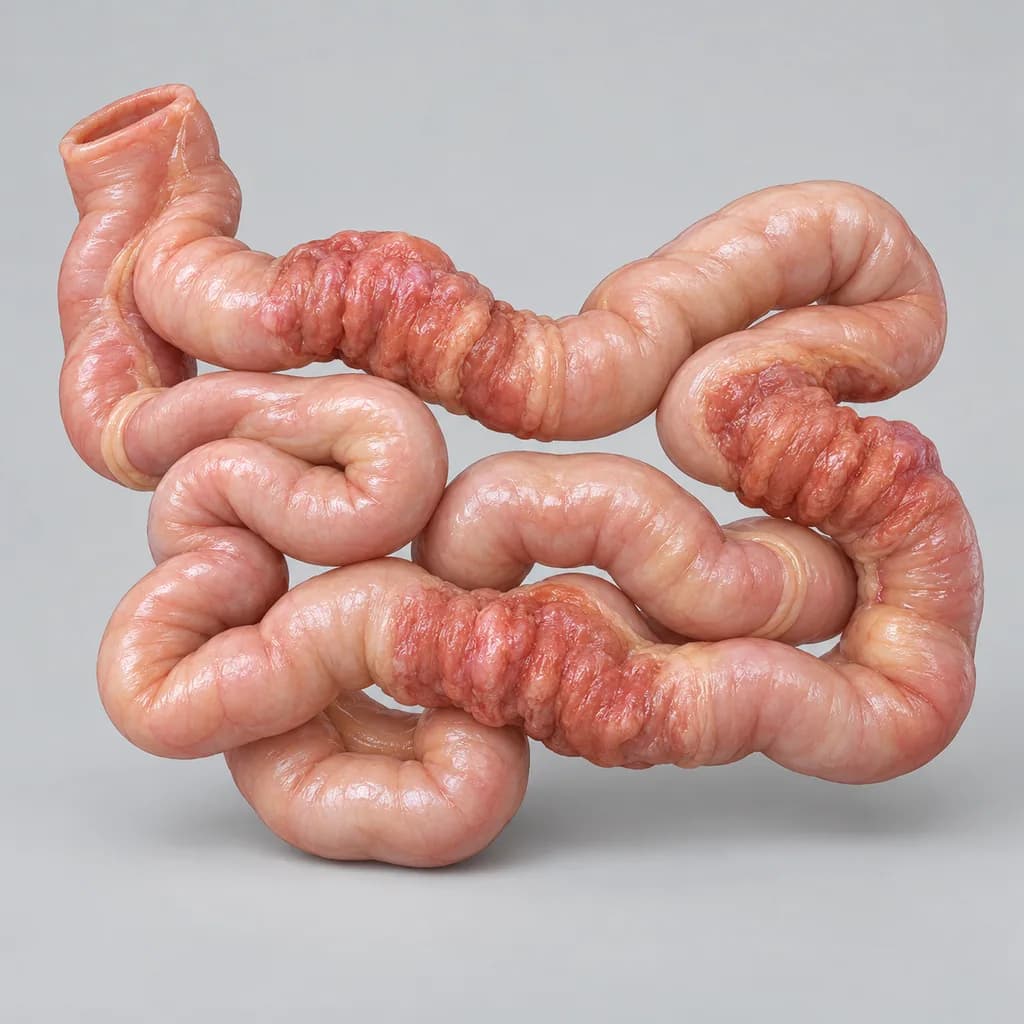
Crohn's disease is a form of inflammatory bowel disease in which the immune system drives chronic inflammation of the digestive tract. It can appear anywhere from the mouth to the anus, most often where the small intestine meets the colon. Dr. Ihab Herraka provides Crohn's disease care in Fort Smith, from the first work-up through years of maintenance treatment. Two features shape everything that follows. Crohn's is patchy, so inflamed segments sit between stretches of healthy bowel, and it is transmural, involving the full thickness of the bowel wall rather than only the surface lining. That is why it can narrow the bowel into a stricture or tunnel through it into a fistula, and why a colonoscopy alone does not always tell the whole story. The other main form of inflammatory bowel disease, ulcerative colitis, stays in the colon and rectum and stays on the surface. The distinction is not academic: it decides which medicines are likely to help, whether your small intestine needs imaging, and what surgery can accomplish. Both are part of our inflammatory bowel disease care in Fort Smith. Doctors also describe Crohn's by where it sits, since that shapes symptoms and testing: ileocolitis (the end of the small intestine and start of the colon, the most common pattern), ileitis (small intestine alone), Crohn's colitis (colon alone), gastroduodenal disease (stomach and the first part of the small intestine), and jejunoileitis (patches through the upper small intestine). Many people have more than one pattern at once.
What causes Crohn's disease?
The exact cause is not known, but several factors raise the risk. Crohn's tends to run in families, so a close relative with Crohn's disease or ulcerative colitis raises your own risk. The disease develops when the immune system responds abnormally to the bacteria that normally live in the gut, driving ongoing inflammation instead of settling down. Smoking is the strongest modifiable risk factor, making Crohn's more likely to develop, flare and eventually need surgery. NSAIDs and courses of antibiotics have also been linked to flares in people who already have the disease. Crohn's can start at any age, but most people are diagnosed in their teens through their thirties.
Symptoms
Symptoms depend on where the disease sits, and they usually build over months rather than days.
- Diarrhea lasting weeks, sometimes with blood or mucus
- Crampy abdominal pain, often low on the right side and worse after eating
- Fatigue, low-grade fever and poor appetite
- Weight loss you did not intend, or slowed growth in a child or teenager
- Anemia, low iron or low vitamin B12 turning up on bloodwork
- Pain, swelling, drainage or a tender lump near the anus
- Aching joints, mouth ulcers, red eyes, or tender red bumps on the shins Be seen promptly if diarrhea has lasted more than a few weeks, you are passing blood, you are losing weight without trying, or you have new pain or drainage around the anus. Go to the emergency department for severe abdominal pain with vomiting and an inability to pass stool or gas, a belly that is swollen and rigid, high fever with shaking chills, or heavy rectal bleeding with dizziness. Those point toward a blockage, an abscess or a perforation.
How Crohn's disease is diagnosed
No single test makes the diagnosis. It comes from fitting the history, the labs, the endoscopy and the imaging together, and from ruling out infection and the conditions that imitate it, including IBS. At our Fort Smith Main Clinic that means:
- History and exam. How long symptoms have run, family history, smoking, prior surgery, and every medicine you have tried and stopped. Dr. Herraka examines your abdomen and, when the story calls for it, the perianal area.
- Bloodwork. A blood count for anemia, inflammation markers, and iron, vitamin B12, vitamin D and albumin. Those deficiencies point toward small-bowel disease and need correcting on their own.
- Stool testing. Fecal calprotectin measures inflammation inside the bowel. Stool studies rule out infection, including C. difficile, which can imitate a flare and can also set one off.
- Colonoscopy with biopsies. The cornerstone test. Dr. Herraka examines the colon and passes into the last stretch of small intestine, where Crohn's most often lives, taking biopsies even from lining that looks normal. It is done under sedation in our on-site endoscopy center.
- Small-bowel imaging. Most of the small intestine sits beyond the reach of any scope, so CT or MR enterography is ordered through a local imaging center. It shows how long an inflamed segment is, how thick the wall has become, and whether a narrowing, fistula or abscess is present.
Possible complications
Longstanding inflammation can lead to problems beyond the current flare: strictures (narrowed segments that can cause a blockage), fistulas (abnormal tunnels connecting the bowel to another organ or the skin), abscesses, and perianal disease, all more common in Crohn's than in ulcerative colitis because Crohn's involves the full thickness of the bowel wall. Malnutrition, anemia and low vitamin B12 can develop when inflamed small intestine cannot absorb nutrients normally. Longstanding Crohn's colitis also raises the risk of colorectal cancer, which is why surveillance colonoscopy at set intervals becomes part of long-term care for Crohn's involving the colon, starting earlier and repeating more often than routine colon cancer screening in the general population.
Treatment
The aims are to settle the current flare, keep you in remission without ongoing steroids, heal the lining, and head off the complications that lead to an operation. Settling a flare. Steroids work quickly and are often how treatment starts, but they are induction therapy only. They do not keep Crohn's in remission and long courses cause real harm, so the plan should always include what follows them. Mesalamine, a mainstay in ulcerative colitis, has little role in Crohn's, which is worth knowing if you have taken it for years without much change. Maintenance therapy. Immune-modifying medicines and biologics, given by infusion or self-injection, are joined now by an oral small-molecule drug approved for Crohn's, and current guidance favors starting effective therapy early in moderate to severe disease rather than climbing a ladder while damage accumulates. Which option fits depends on severity, where the disease sits, what you have already taken, your other conditions and what your plan covers, and that decision comes after your evaluation. Immune-suppressing treatment is preceded by screening for tuberculosis and hepatitis B, a vaccination review and baseline labs. Strictures, fistulas and perianal disease. A narrowed segment behaves differently depending on what it is made of. Where the narrowing is mostly active inflammation, treating the inflammation can open it; where it is mostly scar, it needs stretching through a scope or an operation, and imaging is what tells those apart. Abscesses need drainage, and fistulas usually need medicine and a surgeon together. Perianal Crohn's is often mistaken for a stubborn hemorrhoid or an anal fissure, so drainage or a lump near the anus deserves a proper look. Surgery. Removing a diseased segment relieves an obstruction or a complication medicine cannot fix, and many people feel substantially better afterward. It is not a cure: inflammation tends to return at the join, which is why medication usually continues afterward and a colonoscopy six to twelve months later checks for early recurrence before symptoms come back. Everyday care. Stopping smoking is the clearest single thing you can do for yourself, because smoking makes Crohn's more aggressive and raises the chance of needing repeat surgery. No diet causes Crohn's and none cures it, though simpler, lower-fiber foods are often easier to tolerate during a flare or with a known narrowing; in remission, most people return gradually to their usual diet and identify their own trigger foods by reintroducing items one at a time. Correcting iron, B12 and vitamin D is part of the treatment.
Biologic therapy and long-term monitoring
Starting advanced therapy involves paperwork as well as medicine. Nearly every biologic and small-molecule drug requires prior authorization, and our staff files it and follows up rather than leaving that with you. Self-injected biologics are not filled at our on-site pharmacy. They go through the specialty pharmacy your plan uses, and our staff sets that up, files the authorization and follows the first fill through rather than leaving you to chase it. Infusion medicines are given at an infusion center rather than in our office, and Dr. Herraka arranges that referral to Vital Care, Eastern Oklahoma Medical Center or Mercy Hospital and stays involved rather than handing your care off. Depending on the medicine and your plan, a home-infusion service may also be an option instead of traveling to an infusion center. Monitoring is what keeps you out of trouble: periodic blood counts and liver and kidney labs while you are on therapy, inflammation markers and stool calprotectin to show whether the bowel is genuinely quiet, and a repeat colonoscopy at intervals to confirm the lining has healed. Symptoms and inflammation do not always agree, which is why we measure rather than assume. If a flare starts, call instead of waiting for your next visit.
What to expect at your visit
Bring your previous colonoscopy and pathology reports, imaging reports or discs, a medication list including what you tried and stopped, and the dates of any biologic doses. The first visit is a long conversation and an exam, followed by the testing needed to confirm the diagnosis or see where things stand. You leave with a written plan, a results timeline, and clear instructions about when to call and when to go to the emergency department. If you have moved here and are already on therapy, we can continue your care without starting over. For most plans no referral is needed.
Why see Dr. Herraka for Crohn's disease
Dr. Ihab Herraka is board-certified in gastroenterology, internal medicine and obesity medicine, in practice since 2012, and a member of the American College of Gastroenterology (ACG) and the American Society for Gastrointestinal Endoscopy (ASGE). Your consult, colonoscopy and biologic therapy are handled by the same physician at every visit, at an on-site endoscopy center in Fort Smith. Read more on his physician profile.
Seeing the part scopes cannot reach
Crohn's can affect any part of the digestive tract, and a stretch of the small intestine sits beyond the reach of both a colonoscopy and an upper endoscopy. When the picture does not add up, or inflammation is suspected further down, a capsule endoscopy photographs that stretch directly. You swallow a camera the size of a large vitamin and carry on with your day. If you have a known narrowing, tell Dr. Herraka first. A capsule has to be able to pass, and in that situation he will check the path is clear before using one.
Cost & insurance
Office visits, bloodwork, stool testing, colonoscopy and enterography for Crohn's are billed as diagnostic care rather than screening, so your deductible and coinsurance apply as they would for any medical work-up. Advanced therapy is where coverage varies most: prior authorization is close to universal, and plans differ on which drug they want tried first. Our billing team verifies your benefits and starts that process before treatment begins. Most major plans are accepted here, along with Medicare and Medicaid on both the Arkansas and Oklahoma side of the line, and the current list is on our insurance page.
Frequently asked questions
What is the difference between Crohn's disease and ulcerative colitis?
Both are forms of inflammatory bowel disease, but they behave differently. Crohn's can affect any part of the digestive tract in patches and inflames the full thickness of the bowel wall, which is why it can cause strictures and fistulas. Ulcerative colitis affects only the colon and rectum, spreads continuously from the rectum upward, and involves just the surface lining. Colonoscopy with biopsies, along with imaging of the small intestine, is what usually tells them apart.
Can Crohn's disease be cured?
There is no cure, but it can be controlled, and control is a realistic goal rather than a hopeful one. Treatment aims for remission without ongoing steroids and a lining that has healed on endoscopy. Surgery removes a damaged segment but not the disease, since inflammation tends to return at the join.
Why do I need imaging of my small intestine if I already had a colonoscopy?
A colonoscopy reaches only the last stretch of the small intestine, and Crohn's often involves segments well beyond it. CT or MR enterography shows how much of the small bowel is inflamed and whether there is a narrowing, a fistula or an abscess that would change the plan. It answers a question a scope cannot physically reach.
What happens before I can start a biologic for Crohn's disease?
Before a biologic or small-molecule drug is started for Crohn's disease, you are screened for tuberculosis and hepatitis B, your vaccinations are reviewed, and baseline labs are drawn. Your plan will almost certainly require prior authorization, which our staff files on your behalf. The medicine itself is chosen after your evaluation, based on how severe the disease is, where it sits, what you have taken before and what your plan covers.
Does what I eat cause Crohn's flares?
Diet does not cause Crohn's disease and no diet cures it. Certain foods can worsen symptoms without worsening the inflammation, which is why a food that bothers you during a flare may be fine in remission. With a known narrowing, a lower-fiber diet lowers the chance of an obstruction.
What are the early signs of Crohn's disease?
Early signs often include crampy abdominal pain, diarrhea that lasts several weeks, fatigue and a lower appetite than usual. Some people notice unintended weight loss or mild fevers before the diagnosis is clear. These signs can be subtle and easy to attribute to something else, which is why Crohn's is sometimes present for months before it is diagnosed.
Am I at risk of developing other conditions?
Crohn's disease is linked to problems outside the digestive tract, including joint pain, mouth ulcers, eye inflammation and skin changes, which usually improve as the bowel inflammation comes under control. Longstanding Crohn's colitis also raises the risk of colorectal cancer, which is why surveillance colonoscopy becomes part of care over time.
I take a biologic and just moved to Fort Smith. Can you take over my care?
Yes. Bring your last colonoscopy and pathology reports, recent imaging, your current medicine with its dose and dates, and recent lab work. Dr. Herraka reviews where you stand, confirms your monitoring schedule and works with your plan so therapy is not interrupted. We see patients from Fort Smith, the River Valley and eastern Oklahoma.
See a Crohn's disease doctor in Fort Smith
Diarrhea that will not settle, abdominal pain, weight loss or bleeding deserves an answer rather than another round of guessing. Call the Digestive & Liver Center of Arkansas Main Clinic at (479) 242-2888 or request an appointment. Dr. Ihab Herraka sees patients at 3416 Old Greenwood Rd, Fort Smith, AR 72903, Monday through Friday, 8:00 to 5:00, including patients from Poteau, Sallisaw and across eastern Oklahoma, where Oklahoma Medicaid is accepted.