On this page
- What is a FibroScan?
- What CAP and liver stiffness scores mean
- Why FibroScan has replaced biopsy for most patients
- Who needs a FibroScan?
- How to prepare for your FibroScan
- Your 10-minute appointment, step by step
- How your results are explained
- Cost & insurance
- Frequently asked questions
- Get a clear answer about your liver
A FibroScan measures how much fat and how much scarring are in your liver, in about ten minutes, with no needle, no sedation and no downtime. You lie on your back and a probe rests on your side. It is done in our Fort Smith office, and for most people it answers the question a biopsy used to.
What is a FibroScan?
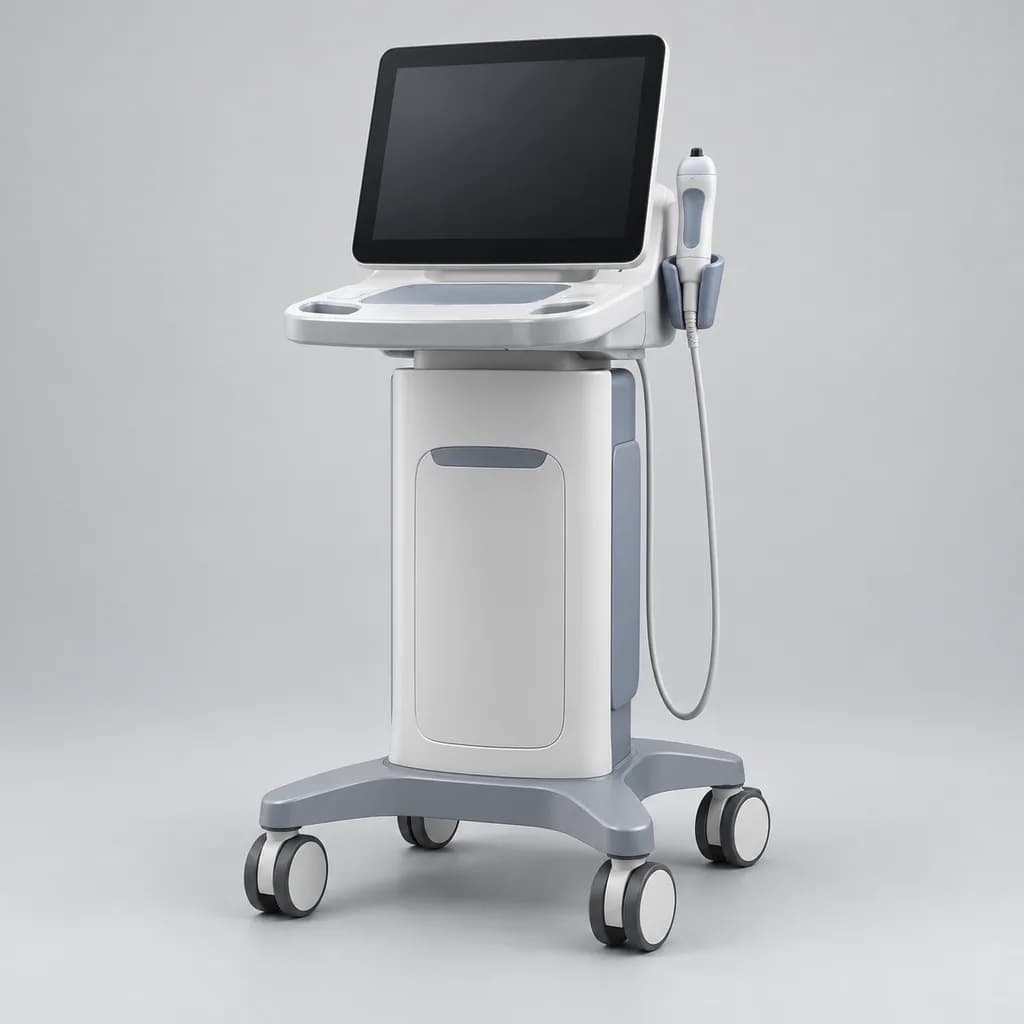
A FibroScan is a painless, 10-minute ultrasound-based scan that measures how much fat and how much scarring are in your liver, without a needle, sedation or downtime. You lie on your back, a small probe rests on your side, and you walk out with numbers the same day. The medical name for the technology is transient elastography. The probe sends a gentle pulse into the liver and measures how quickly the wave travels through it. A healthy liver is soft and the wave moves slowly. A scarred liver is stiffer and the wave moves faster. At the same time, the machine measures how much the signal fades, which tells us how much fat is present. FibroScan is offered in-office at Digestive & Liver Center of Arkansas in Fort Smith. Very few clinics in the River Valley have this technology on site, so patients often travel from Van Buren, Greenwood, Alma, Barling, Charleston and from Poteau and Sallisaw in eastern Oklahoma to have it done.
What CAP and liver stiffness scores mean
A FibroScan gives you two numbers, and they answer two different questions. CAP score: how much fat is in your liver. CAP stands for controlled attenuation parameter and is reported in decibels per meter (dB/m). A higher CAP suggests more fat in the liver cells, a condition your reports may call hepatic steatosis, fatty liver, NAFLD or MASLD. Liver stiffness measurement: how much scarring is in your liver. This is reported in kilopascals (kPa). A higher number suggests a stiffer, more scarred liver. Stiffness is then translated into a fibrosis stage from F0 (no scarring) to F4 (cirrhosis). The stiffness number matters more for your long-term health than the fat number does. Fat alone is common and often manageable. Scarring is what determines risk over the years ahead. One important caution: the score ranges that separate one fibrosis stage from the next are not identical for every liver condition, and a single reading is interpreted alongside your bloodwork, your body type and your medical history. That is why a FibroScan result should be explained by a physician rather than compared against a chart you found online. Our page on MASH and liver fibrosis walks through what each stage means.
Why FibroScan has replaced biopsy for most patients
For decades, staging liver scarring meant a liver biopsy, a needle passed through the skin to take a small sample of liver tissue. Biopsy still has a role, but it is no longer the first step for most people with fatty liver disease. FibroScan is preferred in most cases because it is painless, takes about ten minutes with no sedation and no recovery, can be repeated in a year to see whether your liver is improving, samples far more of the liver than the sliver a needle retrieves, and carries none of a biopsy's procedural risk. Biopsy still has a real role when non-invasive tests disagree with each other, or when a second liver condition may be present alongside fatty liver. We set the two out honestly, including what biopsy still does better, on FibroScan vs. liver biopsy.
Who needs a FibroScan?
A FibroScan is worth doing if you have any reason to suspect fat or scarring in your liver, even when you feel completely well. Fatty liver disease is usually silent until it is advanced. Consider a FibroScan if you:
- Were told you have a fatty liver on ultrasound, CT or MRI
- Have liver enzymes (ALT or AST) that keep coming back abnormal: see elevated liver enzymes
- Have type 2 diabetes, prediabetes or insulin resistance
- Are carrying excess weight, especially around the middle
- Have metabolic syndrome, high triglycerides or high blood pressure
- Have already been diagnosed with MASLD, NAFLD, MASH or NASH and need to know your stage
- Have a history of hepatitis B or hepatitis C
- Are being monitored for known liver fibrosis and need a follow-up measurement If you already know you have fatty liver disease but nobody has ever staged it, a FibroScan is the missing piece. "You have a fatty liver" and "you have F3 scarring" call for very different plans.
How to prepare for your FibroScan
Preparation is simple, and fasting is the one step that really matters.
- Do not eat for at least 3 hours before your appointment. Food in the stomach can raise your stiffness reading and make the result less accurate. Most patients find a morning appointment easiest.
- Water is usually fine. Plain water in the hours before the scan does not interfere with the measurement.
- Take your regular medications as usual, unless our office has specifically told you otherwise.
- Wear a two-piece outfit. We need to reach the right side of your rib cage, so a top that lifts easily is more comfortable than a dress.
- Bring your records. Recent bloodwork, any ultrasound, CT or MRI reports, a current medication list, your insurance card and photo ID all help us interpret your scan on the spot.
- Tell us in advance if you are pregnant or have an implanted electronic device, such as a pacemaker or defibrillator. In those situations FibroScan is generally not used, and we will arrange a different way to assess your liver.
Your 10-minute appointment, step by step
There is nothing to be nervous about. Most patients are surprised by how ordinary it feels. 1. Check in and a short review. We confirm how long you have fasted and go over your history, medications and any prior liver results. 2. Getting positioned. You lie flat on your back on the exam table and raise your right arm above your head, which opens the spaces between your ribs. You stay fully covered except for a small area on your right side. 3. Gel and probe. A small amount of water-based gel goes on the skin, then the probe rests between two ribs over the liver. Nothing is inserted and nothing pierces the skin. 4. The measurements. You will feel a light tap or flick each time a reading is taken, and most people describe it as a gentle vibration. We take about ten valid readings and may ask you to hold still or breathe normally at certain moments. This part takes only a few minutes. 5. Done. The gel wipes off, you get dressed, and that is it. There is no sedation, so you can drive yourself home, return to work, and eat as soon as you like. From walking in to walking out, expect roughly 10 minutes for the scan itself and a little longer for the visit around it.
How your results are explained
Your FibroScan produces results immediately, which is one of the best things about it. In most cases you will not wait days for a phone call. We review three things together:
- Your fat score (CAP) and what it says about how much fat your liver is carrying
- Your stiffness score (kPa) and the fibrosis stage it points to, from F0 through F4
- The context: your liver enzymes, your FIB-4 blood score, your blood sugar and cholesterol, and any prior imaging From there we explain, in plain language, whether your liver looks stable or whether it needs active treatment. For some patients the honest answer is monitoring and lifestyle support. For others, especially those staged at F2 or F3, treatment becomes more active and may include medication. The stage is what establishes eligibility for Rezdiffra (resmetirom), and it is also what separates fibrosis that can still improve from cirrhosis, which is managed rather than reversed. Because Dr. Herraka is board-certified in gastroenterology, internal medicine and obesity medicine, the plan usually addresses the metabolic drivers too, often through our medical weight loss program; see how fatty liver and weight loss are treated as one problem rather than two. One honest limitation: a FibroScan can be less reliable in certain situations, including recent eating, significant fluid in the abdomen, narrow spaces between the ribs, or a very large body size when the standard probe is used. When a reading looks unreliable, we say so, and we repeat it or use another approach rather than acting on a shaky number.
Cost & insurance
FibroScan is a diagnostic test, and when it is medically appropriate it is covered by most major insurance plans in Arkansas, including Medicare. Medicare, both Arkansas and Oklahoma Medicaid and the major commercial carriers are accepted, and self-pay pricing exists for elective services. The current list is kept on our insurance page. What you owe depends on your specific plan, your deductible and where you are in your plan year, so we do not post prices online. For general reference, third-party cost-comparison sites report self-pay FibroScan prices nationally averaging around $242 to $299, though these are not DLC prices and your actual cost depends on your plan, your location, and whether the test is billed as part of a broader liver workup. Call our office and our team will verify your benefits before your appointment so you know what to expect ahead of time.
Frequently asked questions
Does a FibroScan hurt?
No. It feels much like a standard ultrasound, with a light tap or flick each time a reading is taken. There is no needle, no numbing medicine and no sedation. Nearly all patients describe it as completely comfortable.
Do I have to fast before a FibroScan?
Yes. Plan on no food for at least 3 hours beforehand, because eating temporarily raises liver stiffness readings and can push your result into a higher range than your liver really deserves. Plain water is generally fine, and you should take your usual medications unless we tell you otherwise.
How long does the whole appointment take?
The scan itself takes about 10 minutes. Allow extra time for check-in and for reviewing your results with the physician. You can drive yourself home afterward and go straight back to work or your normal routine.
Do I need a referral, or can I book directly?
In most cases you can contact our office directly and no referral is required. If your particular plan requires one, our team will help you coordinate it with your primary care provider.
Is a FibroScan the same as a regular ultrasound?
No. Both use sound waves and a probe placed on your skin, but they measure different things. A regular abdominal ultrasound creates a picture of the liver's shape and structure, and it can show fat or an irregular surface, but it cannot reliably measure how much fat or scarring is present. We do both on site at our Fort Smith clinic, including liver Doppler ultrasound to check blood flow, and they are often used together rather than one instead of the other. A FibroScan uses a different technology, transient elastography, specifically to produce two numbers: a fat score (CAP) and a stiffness score (kPa) that stages your liver.
Does a FibroScan involve radiation?
No. FibroScan uses sound waves, the same basic principle as an ultrasound, and involves no radiation, no needles, and no dye or contrast injection. That is part of why it is considered safe to repeat as often as your liver care requires.
How often should a FibroScan be repeated?
It depends on what the first scan shows. Many patients being monitored for fatty liver are rescanned about a year later to see whether fat and stiffness are improving. If you are in active treatment or at a more advanced stage, we may recommend a different interval and pair it with periodic bloodwork.
Get a clear answer about your liver
If you have been told you have a fatty liver, your enzymes keep coming back high, or you simply want to know whether your liver is stable, a FibroScan can give you a real answer in about 10 minutes. Call Digestive & Liver Center of Arkansas at (479) 242-2888 to schedule. We are at 3416 Old Greenwood Rd, Fort Smith, AR 72903, open Monday through Friday, 8:00 a.m. to 5:00 p.m., and we welcome patients from throughout the Arkansas River Valley and eastern Oklahoma.