

On this page
What is a peptic ulcer?
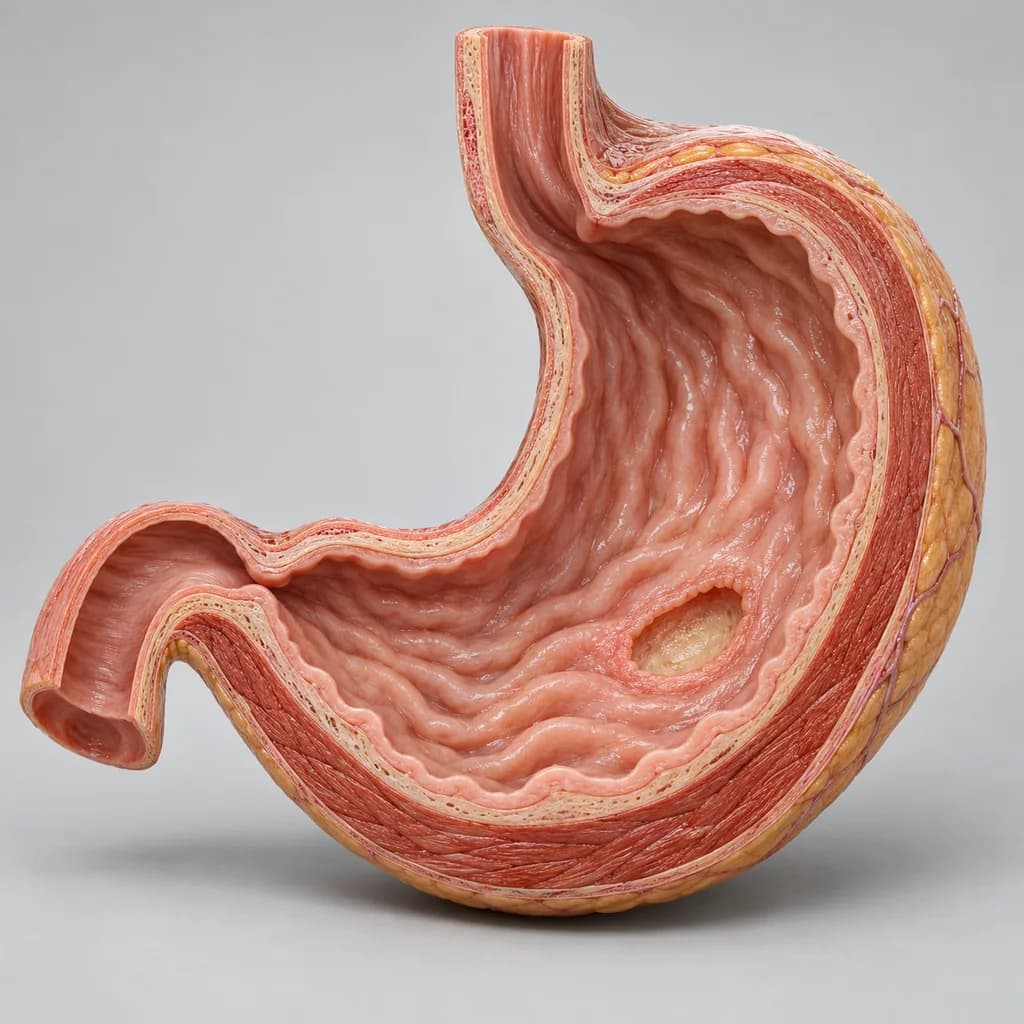
A peptic ulcer is an open sore in the lining of the stomach or in the duodenum, the first stretch of small intestine past it. The lining is normally protected from stomach acid, and an ulcer forms where that protection breaks down. Two things cause the great majority of ulcers: Helicobacter pylori, a bacterium that settles into the stomach lining years before it causes trouble, and regular use of NSAID pain relievers such as ibuprofen, naproxen and aspirin. Stress and spicy food do not cause ulcers, though they can make an existing one hurt more. Dr. Ihab Herraka tests for and treats both causes at our Main Clinic in Fort Smith, alongside the other upper GI conditions that produce the same burning ache. H. pylori is worth finding even when there is no ulcer: it inflames the stomach lining, a condition called gastritis, and, over a long period, raises the risk of stomach cancer. Not everyone with gastritis or H. pylori has a visible ulcer, and not everyone with an ulcer has H. pylori, so testing sorts out which is present. Current guidance is to cure H. pylori whenever it is found rather than watch it. People who share a household with someone diagnosed are sometimes tested as well, since the infection can spread between close contacts.
Symptoms
Ulcer pain is usually a gnawing or burning discomfort in the upper abdomen, between the breastbone and the navel:
- Pain in bouts over days or weeks, often when the stomach is empty or during the night
- Pain that eases with food or antacids, or in some people worsens after eating
- Bloating, early fullness, belching, nausea
- Loss of appetite and unintended weight loss Many people with H. pylori feel nothing at all, and some ulcers announce themselves only when they bleed. Be seen promptly if upper abdominal pain has lasted more than a couple of weeks, comes with weight loss or vomiting, or is joined by trouble swallowing or new anemia, and for indigestion that starts after age 60. Go to the emergency department for vomiting blood or material that looks like coffee grounds, black tarry stools or visible blood in the stool, sudden severe abdominal pain, or lightheadedness with a racing heart. Those point to a bleeding or perforated ulcer.
How ulcers and H. pylori are diagnosed
The infection can be found without a scope; the ulcer itself cannot.
- Urea breath test. You drink a test solution and breathe into a container. It detects active infection and is one of the two preferred tests.
- Stool antigen test. A stool sample tested for H. pylori protein. Equally reliable and often easier to arrange.
- Biopsy during upper endoscopy. Small painless samples taken from the stomach lining while you are sedated, at our on-site endoscopy center. This is the route when a scope is needed anyway, and the only way to see an ulcer directly.
- Blood antibody testing is not used to diagnose active infection, because antibodies can stay positive for years after the bacteria are gone. Medication timing changes the result, so it is not a detail. Acid-suppressing medication and antibiotics knock the bacteria down without clearing them, which produces a false negative. Breath, stool and biopsy testing should be done after at least two weeks off a proton pump inhibitor and four weeks after any antibiotic or bismuth; H2 blockers are fine until about 24 hours before testing. The breath test also requires a short fast, generally about an hour without eating or drinking beforehand. Tell us everything you take, including over-the-counter remedies, and we will tell you what to stop, when, and what you may use for symptoms meanwhile.
Treatment
H. pylori is treated with a combination, never a single antibiotic. A course runs about 14 days and pairs acid suppression with two or more antibiotics, often with bismuth. What changed recently is which combination comes first: clarithromycin resistance has risen enough that the older three-drug regimen built around it is no longer a sound first choice, and bismuth-based four-drug therapy is now the usual starting point. Newer regimens built around vonoprazan, a stronger acid blocker than a standard PPI, are also an option in certain cases. Dr. Herraka chooses the regimen from your history, your allergies and any antibiotic you have taken before. Finishing the course matters more than getting through it comfortably. The pill burden is heavy and side effects are common, including a metallic taste, nausea, loose stools, and dark stool and tongue from bismuth, which is harmless in itself. Bismuth's black stool is not the black, tarry, foul-smelling stool of a bleeding ulcer, and it should not be used to explain away bleeding. If the stool is sticky and tarry, or you feel lightheaded, get checked the same day. Stopping the course early is one of the main reasons treatment fails, and it is how a resistant infection gets started. Confirming the infection is gone is part of the job, not an optional extra. Retesting with a breath or stool test at least four weeks after the last antibiotic, and after a pause off acid suppression, is the only way to know the course worked. If it is still positive, the next regimen uses different antibiotics rather than a repeat of the same ones. NSAID ulcers are treated by removing the cause. That means stopping the anti-inflammatory where possible, healing the ulcer with acid suppression over roughly four to eight weeks, and agreeing with your prescriber on what to use instead. When an NSAID has to continue, it is paired with ongoing acid protection. A stomach ulcer is often rechecked by endoscopy to confirm it has healed.
What to expect at your visit
Bring every medication and supplement, including over-the-counter pain relievers and anything you take for heartburn, and tell us when you last took a proton pump inhibitor or an antibiotic, since that sets when we can test. Bring prior results too: a positive antibody test from years ago is not the same as an active infection today. You leave with a testing plan, a date, and instructions on what to stop and when. Most plans do not require a referral.
Cost & insurance
H. pylori testing, office visits and endoscopy are billed as diagnostic medical care and are covered by most plans when clinically indicated. We accept Medicare, Arkansas and Oklahoma Medicaid, and most regional commercial plans; the current list is on our insurance page. Antibiotic regimens are ordinary prescriptions, so cost depends on your pharmacy benefit. A direct-to-consumer breath test bought online tests for the infection but does not include a treatment plan, dosing guidance or a test of cure, which is where insurance-billed care through our office differs.
Frequently asked questions
How do I get tested for H. pylori?
Three tests are used: a urea breath test, a stool antigen test, or biopsies taken during an upper endoscopy. Breath and stool testing are non-invasive and detect active infection. A blood antibody test is not the right tool, because it can stay positive long after the bacteria are gone.
Do I have to stop my acid reflux medicine before an H. pylori test?
Yes, in most cases. Proton pump inhibitors such as omeprazole suppress the bacteria enough to produce a false negative, so they are stopped about two weeks before a breath, stool or biopsy test, and recent antibiotics or bismuth require about four weeks. Do not stop a prescribed medication on your own. Call the office and we will tell you what to hold and what you can use for symptoms meanwhile.
How long does H. pylori treatment take?
Most regimens run about 14 days and combine an acid-reducing medication with two or more antibiotics, often with bismuth. Symptoms usually improve during or shortly after the course, but an ulcer takes longer to heal, so acid suppression is often continued for several weeks afterward. Taking every dose on schedule is what separates a cure from a resistant infection.
How do I know the infection is actually gone?
By testing again, symptoms cannot tell you. H. pylori is confirmed cleared with a breath or stool test done at least four weeks after the final antibiotic dose and after a pause off acid suppression. Blood antibody tests cannot answer this question, because they stay positive after the bacteria are gone. First-line treatment does not succeed in everyone, and when it fails, a different combination of antibiotics is used rather than a repeat of the first.
Do peptic ulcers go away on their own?
Rarely, and not reliably. An ulcer can quiet down for a while, but if H. pylori or ongoing NSAID use is still there, it tends to come back or worsen, sometimes without warning symptoms first. Treating the underlying cause, rather than waiting it out, is what actually heals it and keeps it from returning.
Do I need an endoscopy, or is a breath test enough?
For many adults under 60 with typical ulcer-type symptoms and no warning signs, testing for H. pylori with a breath or stool test and treating what it finds is a reasonable first step without a scope. Endoscopy is recommended when there is bleeding, weight loss, trouble swallowing, persistent vomiting or anemia, when indigestion is new after age 60, or when symptoms persist despite treatment.
Get tested for H. pylori in Fort Smith
Weeks of burning stomach pain deserve an answer rather than another box of antacids. Call the Digestive & Liver Center of Arkansas Main Clinic at (479) 242-2888 or request an appointment. Dr. Ihab Herraka sees patients at 3416 Old Greenwood Rd, Fort Smith, AR 72903, Monday through Friday, 8:00 to 5:00, including patients from Poteau, Sallisaw and across eastern Oklahoma. If heartburn is the main problem rather than pain, start with GERD and acid reflux.