

On this page
- What is ulcerative colitis?
- What causes ulcerative colitis?
- Symptoms
- How ulcerative colitis is diagnosed
- Treatment
- Cancer surveillance in ulcerative colitis
- What to expect at your visit
- Why see Dr. Herraka for ulcerative colitis
- Cost & insurance
- Frequently asked questions
- Start ulcerative colitis treatment in Fort Smith
What is ulcerative colitis?
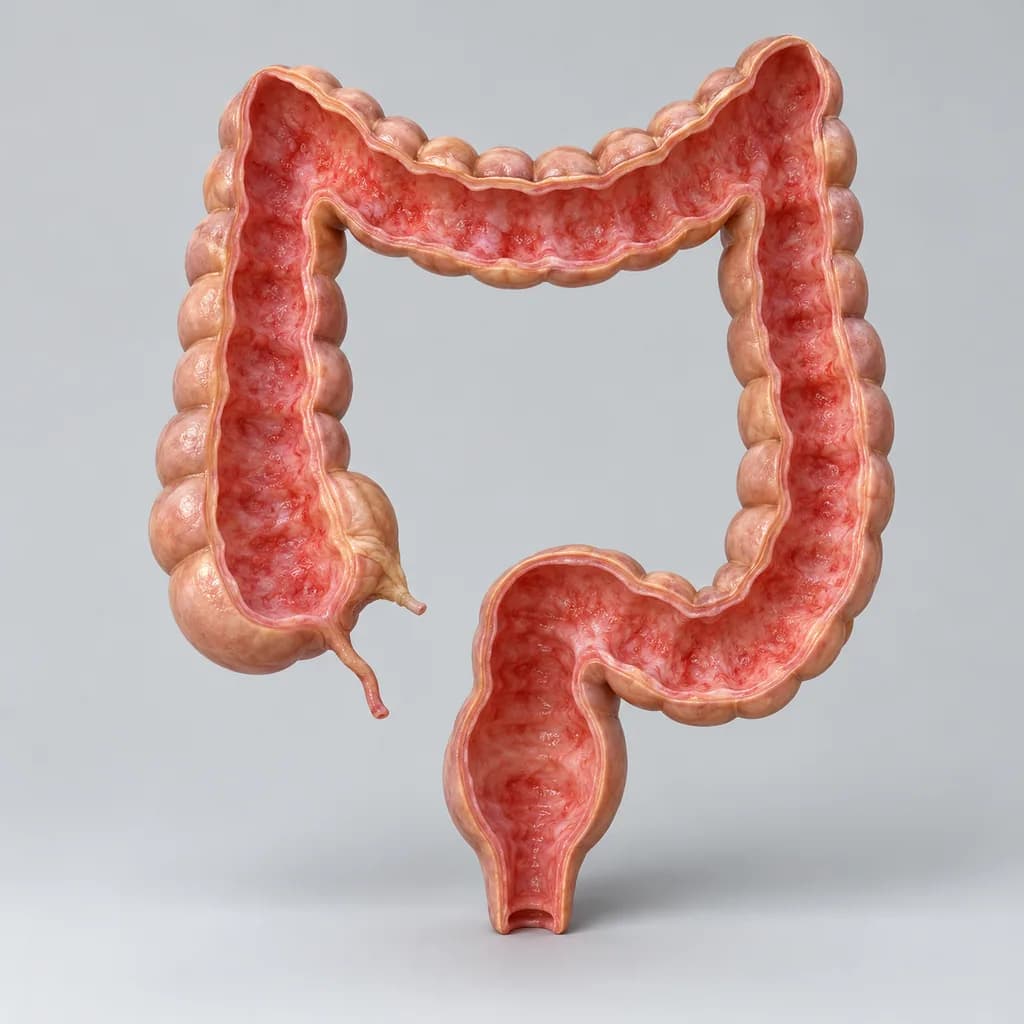
Ulcerative colitis is a form of inflammatory bowel disease in which the immune system causes continuous inflammation of the lining of the large intestine. It begins at the rectum and spreads upward without skipping, and how far it reaches is how it is described: the rectum alone, the left side of the colon, or most of the colon. Dr. Ihab Herraka provides ulcerative colitis treatment in Fort Smith, from a first flare through years of maintenance and surveillance. Two things follow from that pattern. Because the rectum is always involved, bleeding and urgency are the symptoms that dominate. And because the inflammation stays on the surface lining of the colon, it does not tunnel or narrow the way Crohn's disease does, which is also why removing the colon can end the disease when nothing else has worked. That is never true of Crohn's, so the distinction is worth confirming early rather than assuming. Both conditions are part of our inflammatory bowel disease care in Fort Smith. How far the inflammation reaches has a name: ulcerative proctitis (limited to the rectum), proctosigmoiditis or left-sided colitis (extending further up the left side), and extensive colitis or pancolitis (most or all of the colon). Extent can change over time, which is why it is reassessed at colonoscopy rather than assumed from the last exam.
What causes ulcerative colitis?
The exact cause is not known, but several factors raise the risk. Ulcerative colitis tends to run in families, so a close relative with ulcerative colitis or Crohn's disease raises your own risk. It develops when the immune system responds abnormally in the colon, with environmental factors playing some role researchers do not yet fully understand. Some people develop symptoms in the weeks after a gut infection or a course of antibiotics, and NSAIDs such as ibuprofen and naproxen can provoke flares. Smoking behaves differently here than in most conditions: current smokers appear to have a somewhat lower risk of developing it, and ex-smokers a somewhat higher one, but this is not a reason to smoke, since smoking carries far greater health risks overall.
Symptoms
Symptoms come in flares that can last weeks, separated by stretches when you feel well.
- Diarrhea mixed with blood or mucus, often several times a day
- Urgency, and accidents when a bathroom is not close
- A constant feeling that you need to go again after you have gone
- Crampy pain low in the abdomen, often easing after a bowel movement
- Being woken at night by the need to have a bowel movement
- Fatigue, anemia, low appetite and weight loss during a flare
- Aching joints, mouth ulcers, red or painful eyes, or tender red bumps on the shins Be seen promptly if you have bloody diarrhea for more than a few days, urgency you cannot control, or a flare that is not responding to your usual plan. Bleeding is never something to diagnose yourself; see our page on rectal bleeding for what else can cause it. Go to the emergency department for many bloody stools a day together with fever, a racing heart or lightheadedness, for severe abdominal pain with a swollen, tender belly, or for bleeding heavy enough to make you dizzy. Those signs can point toward toxic megacolon or a perforation, rare but serious complications of a severe flare. A severe flare is treated in the hospital, and treating it early is what lowers the chance of it becoming dangerous.
How ulcerative colitis is diagnosed
The diagnosis rests on seeing the inflammation and proving what is causing it, because infections produce an identical picture. At our Fort Smith Main Clinic:
- History and exam. How many stools a day, how much blood, whether symptoms wake you, recent antibiotics or travel, family history, and any medicine that could be contributing, including anti-inflammatory pain relievers.
- Bloodwork. A blood count for anemia, inflammation markers, iron studies, and liver enzymes, which are followed over time because ulcerative colitis is associated with primary sclerosing cholangitis, a bile duct condition that usually shows up first as elevated liver enzymes and that changes how often you need a colonoscopy.
- Stool testing. Cultures and testing for C. difficile come first, since infection can imitate a flare and can also trigger one in someone who already has colitis. Fecal calprotectin measures how much inflammation is present.
- Colonoscopy with biopsies. This confirms the diagnosis and maps how far up the colon the inflammation reaches, which decides both your treatment and your surveillance schedule later. Biopsies separate ulcerative colitis from infection and from Crohn's. The exam is done under sedation in our on-site endoscopy center. During a severe flare, a flexible sigmoidoscopy, a shorter, gentler exam of the lower colon, is used instead, and the full exam waits until things calm down.
Treatment
Treatment is chosen by how far the disease extends and how severe it is, and the target is remission that lasts without steroids, with a lining that has healed rather than symptoms that have merely quieted. Mesalamine, oral and rectal. For mild to moderate disease, mesalamine is still first-line, which is a real difference from Crohn's, where it does little. The part patients most often miss is the rectal form: suppositories and enemas deliver medicine straight to the rectum and lower colon, where ulcerative colitis always starts, and used together with a pill they work better than either alone. Steroids for flares only. Steroids bring a flare down quickly but do nothing to keep you in remission, and staying on them causes harm. Needing repeat courses, or relapsing whenever the dose comes down, is the signal to change maintenance treatment rather than repeat the steroid. Advanced therapy. For moderate to severe disease, steroid dependence, or disease that keeps breaking through, the options have widened considerably: immune-modifying medicines, biologics given by infusion or self-injection, and oral small-molecule drugs, several of them approved specifically for ulcerative colitis in recent years. Which one to use depends on severity, extent, your other conditions, what you have already taken and what your plan will cover. Dr. Herraka makes that recommendation after your evaluation, and screening for tuberculosis and hepatitis B along with a vaccination review comes first with any immune-suppressing treatment. Prior authorization is close to universal and our staff files it, self-injected medicine is filled through the specialty pharmacy your plan uses rather than our on-site pharmacy, and infusion medicines are given at an infusion center Dr. Herraka arranges, usually Vital Care, Eastern Oklahoma Medical Center or Mercy Hospital, with a home-infusion service sometimes an option depending on the medicine and your plan. Measuring the response. Feeling better is the beginning, not the end. Inflammation markers, stool calprotectin and a repeat endoscopy at a planned interval show whether the lining has healed, and a healed lining is what predicts fewer flares and fewer hospital stays. If the target has not been met, the plan is adjusted rather than repeated. Surgery. A minority of people with ulcerative colitis eventually need surgery, and removing the colon ends the colitis, which is something no operation can do for Crohn's, since Crohn's can return anywhere in the digestive tract. It is considered for a severe flare that does not respond to hospital treatment, for disease that will not stay in remission despite good therapy, and if precancerous changes or cancer are found. Many patients go on to a J-pouch, built from the small intestine so stool passes the usual way rather than into a bag; it is normally built in stages, and inflammation of the pouch afterward is common enough to be worth hearing about beforehand. Dr. Herraka coordinates with a colorectal surgeon and stays involved before and after. Everyday care. No diet causes ulcerative colitis or cures it, though correcting iron after bleeding and protecting bone after steroid courses both matter. Anti-inflammatory pain relievers such as ibuprofen and naproxen can provoke flares in some patients, so ask before using them regularly. If you are prescribed antibiotics for something unrelated, mention your colitis, because a C. difficile infection afterward is a common reason for a flare that will not respond.
Cancer surveillance in ulcerative colitis
Years of inflammation in the colon raise the risk of colorectal cancer, and this is the part of ulcerative colitis care most often dropped once patients feel well. The risk is tied to how much of the colon is involved, how long you have had the disease and how much inflammation has been present along the way, which is one more reason to control inflammation properly rather than only until symptoms stop. Following current gastroenterology society guidance, for left-sided or more extensive colitis, surveillance colonoscopy usually begins about eight years after symptoms started and then repeats every one to three years, with the interval set by what previous exams found, how well inflammation has been controlled, and family history. Disease limited to the rectum generally does not need it. If you also have primary sclerosing cholangitis, surveillance starts at diagnosis and repeats every year. A surveillance exam is not the same as a routine screening exam. It is best done when the colitis is in remission, because inflamed lining is hard to read, and it involves a slow, careful inspection with targeted biopsies of anything abnormal plus samples of normal-looking lining. That is why it takes longer than a standard colon cancer screening colonoscopy, and why keeping the interval matters more than it feels like it should after years of feeling well.
What to expect at your visit
Bring your previous colonoscopy and pathology reports, recent lab work, and a list of every medicine you take, including rectal treatments and anything you stopped because it did not seem to help. Expect a detailed conversation about the pattern of your symptoms, an exam, then stool testing and bloodwork, with a colonoscopy scheduled to confirm the diagnosis or reassess the extent. You leave with a written plan that includes what to do if a flare starts, when to call, and when to go to the emergency department. For most plans no referral is needed.
Why see Dr. Herraka for ulcerative colitis
Dr. Ihab Herraka is board-certified in gastroenterology, internal medicine and obesity medicine, in practice since 2012, and a member of the American College of Gastroenterology and the American Society for Gastrointestinal Endoscopy. Flare care, maintenance therapy and surveillance colonoscopy are handled by the same physician at every visit, at an on-site endoscopy center in Fort Smith. Read more on his physician profile.
Cost & insurance
Office visits, labs, stool studies and colonoscopy for ulcerative colitis are billed as diagnostic care rather than preventive screening, surveillance exams included, so deductibles and coinsurance apply the way they do for other medical care. Advanced therapy nearly always requires prior authorization, and plans differ on which treatment they expect to be tried first; our staff handles that paperwork and tells you what your plan requires before treatment starts. We take most major insurance, Medicare, and Medicaid in both Arkansas and Oklahoma, with the current list on our insurance page.
Frequently asked questions
Can ulcerative colitis turn into Crohn's disease?
They are separate conditions, and one does not become the other. Occasionally the picture is unclear at first, since early inflammation limited to the colon can look the same either way, and the diagnosis is revised later as biopsies, imaging or the behavior of the disease add information. That is a refinement of the diagnosis, not a change in the disease.
Does ulcerative colitis increase my risk of colon cancer?
Yes, it raises the risk over time, which is why surveillance colonoscopy is part of long-term care. How much depends on how far the colitis extends, how many years you have had it, and how well the inflammation has been controlled. Disease limited to the rectum carries little added risk.
How often will I need a colonoscopy with ulcerative colitis?
For colitis extending beyond the rectum, surveillance generally starts about eight years after symptoms began and repeats every one to three years. The interval depends on what previous exams showed, how well controlled the inflammation has been, and family history. With primary sclerosing cholangitis it starts at diagnosis and repeats yearly. Separately, a colonoscopy may be done sooner to assess a flare or confirm the lining has healed.
Can I stop my ulcerative colitis medication once I feel better?
No. Stopping maintenance treatment once symptoms settle is one of the most common reasons a flare comes back. Maintenance medicine is what keeps the inflammation suppressed, and inflammation often continues in the lining after symptoms are gone, which is why ulcerative colitis treatment is guided by testing rather than by how you feel. If a medicine causes side effects, say so at your visit so it can be changed rather than abandoned.
Does ulcerative colitis ever go away?
There is no cure short of removing the colon, but it can go into remission, sometimes for years, with treatment. Inflammation can still be present in the lining after symptoms are gone, which is why maintenance treatment continues during quiet stretches.
How can I prevent ulcerative colitis flare-ups?
There is no guaranteed way to prevent every flare, but staying on maintenance treatment even when you feel well is the most effective step, along with using NSAIDs sparingly and telling us before starting antibiotics for something unrelated.
What should I eat if I have ulcerative colitis?
No specific diet causes or cures ulcerative colitis. Bland, lower-fiber foods are often easier to tolerate during a flare, and most people return to a regular, varied diet in remission and learn their own patterns along the way.
Why did my doctor prescribe a suppository or enema?
Because ulcerative colitis always involves the rectum, and rectal medicine reaches that tissue at a far higher concentration than a pill does. For disease limited to the rectum or left colon, rectal mesalamine often controls symptoms better than oral treatment, and combining the two works better than either alone. Many patients skip this step because it is unappealing, then conclude the treatment failed when it was never fully tried.
I'm already on a biologic and moving to Fort Smith. Can you continue my care?
Yes. Bring your last colonoscopy and pathology reports, recent imaging if you have had any, your current medicine with its dose and dates, and recent lab work. Dr. Herraka reviews where you stand, confirms your monitoring and surveillance schedule, and works with your plan so therapy is not interrupted.
Do I need a referral to be seen for ulcerative colitis in Fort Smith?
For most plans, no. You can call our office and schedule directly, and our staff will tell you whether your particular plan requires a referral and help arrange it. We see patients from Fort Smith, the River Valley and eastern Oklahoma, including Poteau and Sallisaw, and Oklahoma Medicaid is accepted.
Start ulcerative colitis treatment in Fort Smith
Bloody diarrhea, urgency and flares that keep returning are treatable, and they are far easier to control before a flare turns severe. Call the Digestive & Liver Center of Arkansas Main Clinic at (479) 242-2888 or request an appointment. Dr. Ihab Herraka sees patients at 3416 Old Greenwood Rd, Fort Smith, AR 72903, Monday through Friday, 8:00 to 5:00, and welcomes patients traveling from Poteau, Sallisaw and across eastern Oklahoma.