

On this page
What is achalasia?
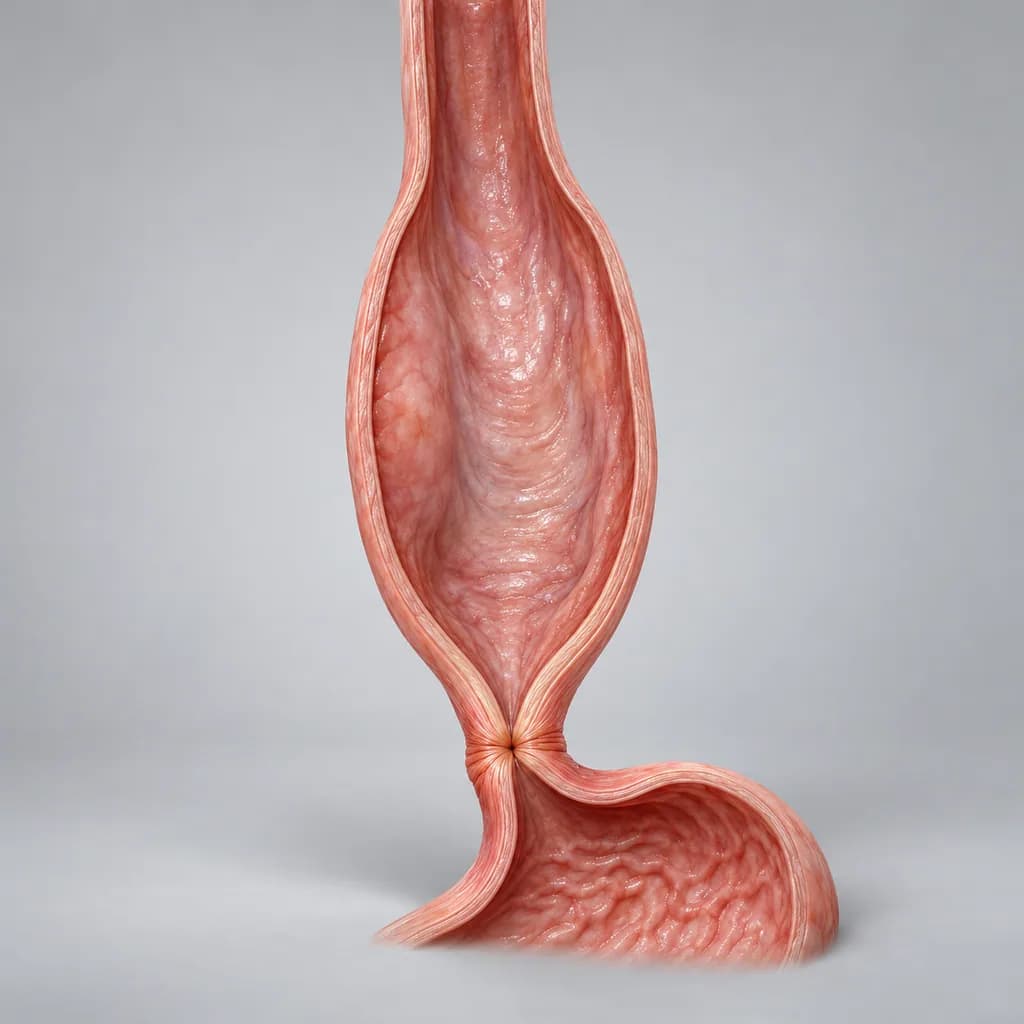
Achalasia is a disorder of the esophagus in which the muscular valve at its lower end fails to relax and open the way it should. Food and liquid pile up above that valve instead of dropping into the stomach, and the body of the esophagus loses its coordinated squeeze, so nothing is pushing the swallow along either. The underlying problem is a loss of the nerve cells in the wall of the esophagus that tell the valve to open. Why they are lost is not fully understood; an immune process is thought to be involved. It is not caused by anything you ate or did. Achalasia is uncommon and comes on slowly, which is why it is so often treated as ordinary reflux for years before it is named. Dr. Ihab Herraka evaluates it at our Fort Smith Main Clinic as part of our care for upper GI conditions, for patients across Arkansas and eastern Oklahoma.
Symptoms
The pattern is what gives achalasia away. A narrowing usually troubles solid food first; achalasia typically makes both solids and liquids hard to get down from early on.
- Trouble swallowing solids and liquids alike, worsening gradually over months or years
- Regurgitation of undigested food, sometimes hours after a meal or onto the pillow overnight
- Chest pressure or pain, often at night or after eating
- Burning treated as heartburn that never really responds to acid medication
- Coughing or waking short of breath after eating
- Weight loss without trying Be seen promptly if swallowing has been getting harder over months, if you are regurgitating undigested food, or if you are losing weight. Symptoms that come on quickly later in life deserve particular attention, because a tumor near the junction of the esophagus and stomach can produce an almost identical picture. Go to the emergency department if food is stuck and will not pass, or if you cannot swallow your own saliva. Chest pain that comes with sweating or breathlessness is treated as a heart attack until proven otherwise, call 911 rather than the clinic.
How achalasia is diagnosed
Achalasia is confirmed with testing, never assumed from symptoms, partly because other conditions imitate it closely.
- Upper endoscopy. Done first, at our on-site endoscopy center, largely to rule things out: a cancer, a stricture or eosinophilic esophagitis can all cause the same complaints. In achalasia the exam may look nearly normal apart from retained food, so a clear scope does not end the search.
- Barium swallow. An X-ray series taken while you drink barium. A widened esophagus tapering to a narrow point at the bottom, often called a "bird's beak," is the classic finding, and a timed version shows how well the esophagus empties.
- Esophageal manometry. The test that confirms it, arranged by referral since it is not done in this office. A thin catheter measures the pressures produced as you swallow, showing the valve's failure to relax and the loss of normal movement above it. It also identifies which of the three types you have. Type I shows little to no pressure in the esophagus body, type II shows pressure building across the whole esophagus at once, and type III shows abnormal, spastic contractions; type II generally responds best to treatment, and the type identified helps guide which option is likely to work.
Treatment
No medication restores the lost nerves, so treatment is aimed at the blockage itself: lowering the resting pressure in that valve so food and liquid can pass. The goal is comfortable eating, not a cure. The established options. Pneumatic dilation widens the valve with a large balloon inflated across it, using X-ray guidance. Laparoscopic Heller myotomy is surgery that divides the muscle of the valve, usually paired with a partial wrap to limit reflux afterward. Peroral endoscopic myotomy, or POEM, divides the same muscle through an endoscope, with no external incision. Each relieves swallowing symptoms for most patients, and each carries risks worth going through beforehand, including a small risk of a tear in the esophagus. Which one suits you depends on your manometry type, your age and health, and your own preferences. None of the three are done in this office: Dr. Herraka refers you to centers that perform them regularly and stays involved in your care afterward. Pneumatic dilation for achalasia is a different procedure from the balloon dilation we do here for a scarred or narrowed esophagus, which uses a much smaller balloon during a routine endoscopy. When those are not an option. Botulinum toxin injected into the valve, also at a referral center, can relieve symptoms for patients who are not candidates for dilation or surgery, though the effect wears off over months and the injection has to be repeated. Calcium channel blockers and nitrates give limited, short-lived relief and are reserved for the same situation. After treatment. Reflux is common once the valve has been opened, so many patients need acid-reducing medication and monitoring afterward. Symptoms can also return years later, and treatment can be repeated or changed. Achalasia is followed for life rather than closed out, and that follow-up happens here in Fort Smith.
What to expect at your visit
Bring your medication list, any prior endoscopy or barium reports, and a rough record of your weight over the past year, and come prepared to describe whether liquids are affected as well as solids. The first visit is a conversation and an exam, then scheduling the testing that fits your pattern. Once results are in, Dr. Herraka goes through what the manometry showed and which treatments are reasonable for your type.
Cost & insurance
Office visits, endoscopy and barium studies are billed under your regular medical benefits, so your deductible and copay apply. Manometry and treatment performed elsewhere are billed by that facility, and some plans require prior authorization first. Most major plans are accepted here, along with Medicare and Medicaid in both Arkansas and Oklahoma, see our insurance page.
Frequently asked questions
What causes achalasia?
Achalasia happens when the nerve cells in the wall of the esophagus that control the valve at its lower end are lost, so the valve does not relax and the esophagus above it stops moving food along. Why those nerves are lost is not fully known, though an immune process is thought to play a part. It is not caused by diet or stress, and it is not usually inherited.
How is achalasia different from acid reflux?
Reflux is acid moving upward out of the stomach; achalasia is food failing to move downward into it. The clues that point away from ordinary reflux are trouble with liquids as well as solids, regurgitation of undigested food rather than sour fluid, and acid medication that has never really helped. See our page on GERD and acid reflux.
What test confirms achalasia?
Esophageal manometry, a pressure study of the esophagus, is the test that confirms achalasia and identifies which type is present. An upper endoscopy is usually done first to exclude a cancer, a stricture and other look-alikes, and a barium swallow shows how the esophagus empties. A normal-looking endoscopy does not rule achalasia out, which is why manometry is needed.
Can achalasia be cured?
No treatment restores the nerves that were lost, so achalasia is managed rather than cured. What treatment can do is reduce the pressure in the valve so food and liquid pass. Symptoms can return over the years and treatment can be repeated or adjusted, so ongoing follow-up is part of the plan rather than a sign something went wrong.
Is achalasia dangerous if it goes untreated?
Untreated achalasia tends to progress. Food retained in the esophagus can be inhaled into the lungs, weight loss can become significant, and the esophagus can stretch and stay stretched over time, which narrows the treatment options later. Achalasia also carries a small long-term increase in the risk of esophageal cancer, though the absolute risk is low and guidelines do not currently recommend routine surveillance endoscopy for everyone with the condition.
Is trouble swallowing always achalasia?
No, and it usually is not, because achalasia is uncommon. Most difficulty swallowing comes from a narrowing caused by long-standing reflux, a ring of tissue in the lower esophagus, or allergic inflammation, and those are diagnosed and often treated in the same endoscopy here, usually by widening the narrowing with balloon dilation.
Get evaluated for achalasia in Fort Smith
If swallowing has been slowly getting harder, liquids are catching too, or reflux treatment has never touched the problem, it is worth finding out why. Call the Digestive & Liver Center of Arkansas Main Clinic at (479) 242-2888 or request an appointment. Dr. Ihab Herraka sees patients at 3416 Old Greenwood Rd, Fort Smith, AR 72903, Monday through Friday, 8:00 to 5:00, including patients traveling from Poteau, Sallisaw and across eastern Oklahoma.