
On this page
What are gallstones?
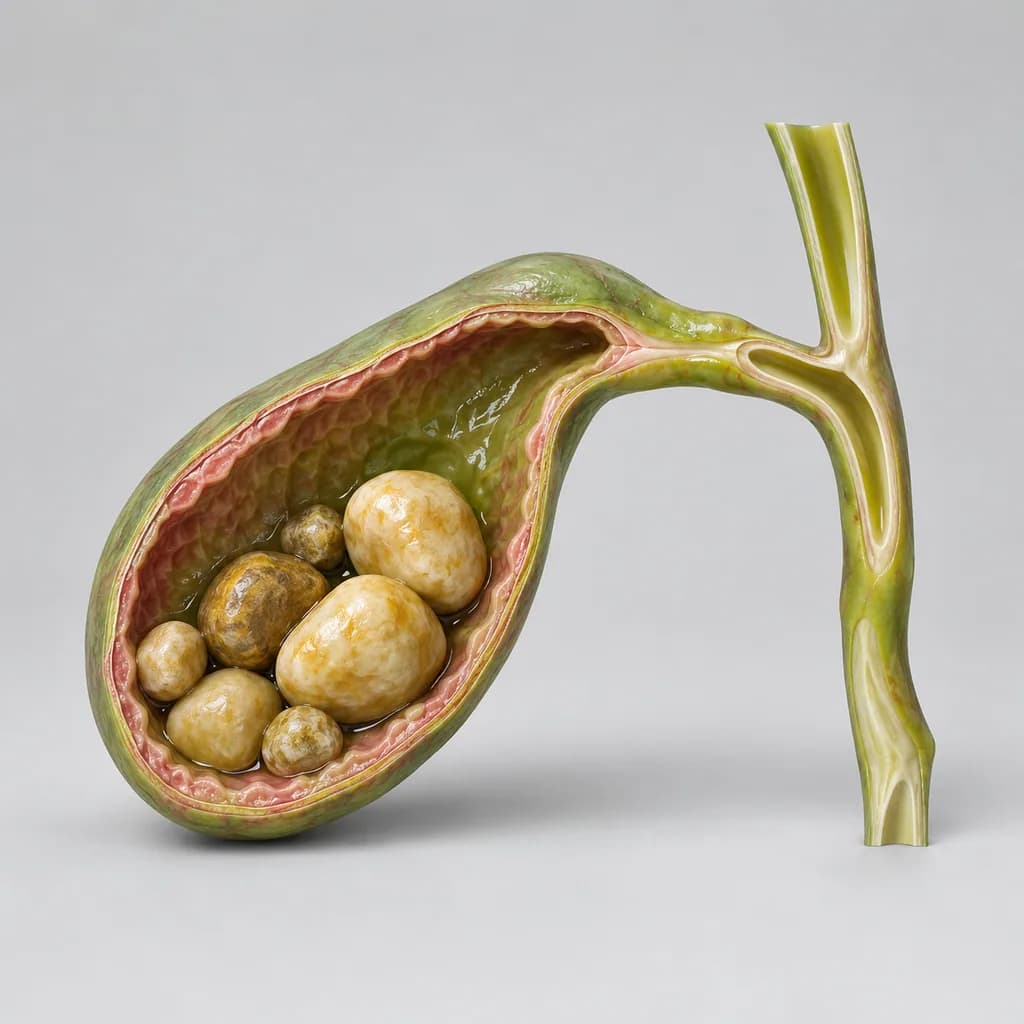
Gallstones are hard deposits that form in the gallbladder, the small organ under the liver that stores bile between meals. Most people who have them never find out, and an ultrasound that finds stones has not proved they are to blame. Reflux, an ulcer, a slow-emptying stomach and irritable bowel all cause pain in the same corner of the abdomen, and a gallbladder removed for the wrong reason leaves the real problem behind. Confirming the pain is biliary is a gastroenterologist's work; removing the gallbladder is a surgeon's. Dr. Ihab Herraka does the first part in Fort Smith, and our upper GI conditions page covers the look-alikes. Stones grow likelier with age, in women, with pregnancy, and with excess weight or diabetes, and also with rapid weight loss, including the fast weight loss that can come with GLP-1 medications, which is one reason medical weight loss is supervised.
Symptoms
Stones sitting quietly cause nothing. When one blocks the outlet, the attack, called biliary colic, has a recognizable shape:
- Steady, intense pain in the upper right abdomen or under the breastbone
- Pain that builds, holds for half an hour to several hours, then fades
- Onset after a meal, often a fatty one, and often at night
- Pain spreading through to the back or right shoulder blade
- Nausea, sometimes vomiting See a doctor promptly after an attack like this, even one that passed on its own, since the next tends to follow. Go to the emergency department for pain lasting more than several hours, fever and chills, yellow eyes or skin, dark urine with pale stools, or severe pain boring through to the back with repeated vomiting. Fever with jaundice points to an infected bile duct; pain through to the back with vomiting points to gallstone pancreatitis. Both are emergencies.
How gallstones are diagnosed
Finding stones is easy. Deciding whether they explain your pain takes judgment.
- History and exam. Where the pain sits, how long it lasts, what sets it off. The pattern carries more weight than any single test.
- Bloodwork. Liver enzymes and bilirubin show whether a stone has reached the bile duct, lipase whether the pancreas is irritated, a blood count whether there is infection.
- Imaging. Ultrasound comes first and is the best test for seeing stones sitting in the gallbladder. When the picture does not fit, a classic story with a clean scan, or bile duct changes on the bloodwork, we arrange further imaging such as a HIDA scan, an MRCP, or endoscopic ultrasound (EUS) when a duct stone is suspected but not clearly seen.
- Testing the other causes. If the pain is not biliary, an upper endoscopy or testing for peptic ulcers and H. pylori matters more than the stones.
Treatment
Silent stones found by chance. No treatment. Stones seen on a scan ordered for something else, in someone who has never had an attack, are left alone. Stones that have caused attacks. Episodes usually keep coming, and complications grow likelier. Removing the gallbladder, most often laparoscopically, is the standard treatment; eating less fat may trigger fewer attacks, but it dissolves nothing and leaves the stones where they are. We do not perform that surgery. Dr. Herraka confirms the diagnosis, rules out the other causes, and coordinates the referral. A non-surgical alternative, with limits. Ursodiol, a bile acid medication, can dissolve certain small, cholesterol-based stones over months of daily use, but it works for a minority of patients, the stones often return once it is stopped, and it does nothing for a stone already causing attacks. It is reserved mainly for patients who are not surgical candidates. A stone that has moved into the bile duct. A stone that slips out of the gallbladder and lodges in the bile duct causes jaundice, dark urine and rising liver numbers, and it has to come out. That is usually done endoscopically, in a hospital procedure called ERCP, timed around any planned gallbladder surgery. It is done in a hospital by a specialist who performs it, not in an office endoscopy suite; Dr. Herraka recognizes the pattern, starts the workup and arranges the referral. A duct stone with fever and chills is an emergency, not a next-available appointment. When it is not the gallbladder after all. GERD, an ulcer or gastroparesis each get treated on their own terms, and you keep an organ you did not need to lose.
What to expect at your visit
Bring your medication list and any imaging you already have. The report matters as much as the pictures. Expect a detailed conversation about the pain and an exam of your abdomen, then bloodwork or imaging that week if needed. You leave knowing whether your symptoms fit gallstones and when to go to the emergency department rather than wait.
Cost & insurance
Office visits, bloodwork and ultrasound for gallbladder symptoms are covered by most plans when medically necessary. Surgery itself is billed by the surgeon and the facility, not by our office. We take most major insurance, Medicare, and Medicaid in both Arkansas and Oklahoma, the list is on our insurance page.
Frequently asked questions
Do gallstones always have to be removed?
No. Stones that have never caused symptoms are usually left alone. Removal is recommended once they cause biliary colic, an inflamed gallbladder, a blocked bile duct or pancreatitis, because those problems tend to repeat.
Why see a gastroenterologist for gallstones instead of a surgeon?
Because someone has to confirm the gallbladder is the problem before it is removed. Upper abdominal pain also comes from reflux, ulcers, a slow-emptying stomach and the pancreas, and gallstones are common enough to be there by coincidence. A gastroenterologist sorts that out, recognizes a stone that has reached the bile duct and gets it treated urgently, and refers you on when surgery is the answer.
What does a gallbladder attack feel like?
A steady, hard pain high in the abdomen, on the right or below the breastbone, building over an hour, often after a fatty meal or at night, and often spreading to the back with nausea. Attacks last half an hour to a few hours; pain going longer, or with fever or yellow eyes, needs emergency care.
Can gallstones be dissolved or flushed out naturally?
Rarely. Prescription bile acid medication works only on certain small stones, takes months, and stones often return, so it is reserved for people who cannot have surgery. Gallbladder flushes sold online do not dissolve stones.
Why are women at greater risk for gallstones?
Estrogen is a large part of the reason. It raises cholesterol levels in bile, which makes stones more likely to form, so pregnancy, birth control pills and hormone therapy all add to the risk on top of the baseline difference between men and women. This is also why pregnancy itself is a known risk factor for gallstones.
Can I live normally without a gallbladder?
Yes. The liver keeps making bile, which drips into the intestine steadily instead of being stored for meals, and most people eat normally afterward. A minority develop loose, urgent stools, called bile acid diarrhea, which usually improves with treatment; see our page on chronic diarrhea.
See a gallbladder specialist in Fort Smith
If a scan found gallstones, or upper abdominal attacks keep coming back, get a clear answer before anything is removed. Call the Digestive & Liver Center of Arkansas Main Clinic at (479) 242-2888 or request an appointment. Dr. Herraka sees patients at 3416 Old Greenwood Rd, Fort Smith, AR 72903, Monday through Friday, 8:00 to 5:00, including patients from Poteau, Sallisaw and across eastern Oklahoma.